





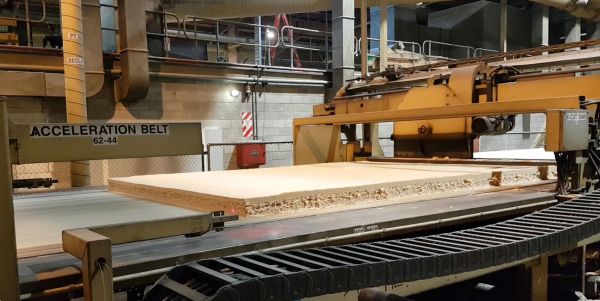
A staged control-system retrofit by CNC Design has brought the electronics on a critical board line in a Northland mill up to modern standards, improving product accuracy, simplifying equipment support, and future-proofing a robust German machine for decades to come.
A Northland tri-board and plywood panel manufacturer had two board lines, both supplied by German manufacturer Industrie-Elektronik and commissioned in 1993. Everything feeds into these lines and then into the hot presses that form the finished panels.
‘The board lines are the heartbeat of the organisation,’ says Jeff Walker, who has led technical support at the timber mill for decades. Mechanically, the board line machines remain solid and reliable. Electronically, they were another story.
CHALLENGE
Obsolete electronics, disappearing knowledge
Both board lines originally ran on tall racks of analogue electronic cards, which was standard technology in their day, but long since superseded by programmable logic controllers (PLCs). We had already partly modernised one of the lines, with an earlier PLC upgrade and several new variable-speed drives (inverters). That left one ageing electronic rack marooned in the middle of an otherwise current system.
The biggest risk in keeping old ‘black box’ technology is in training a new generation to use them. Because the old electronics rarely failed, few technicians ever had the chance to learn them, and those who understood the technology were retiring.
‘When equipment is very reliable, people don’t have to do much with it,’ says Jeff. ‘Then when something does go wrong, you’re on the back foot, trying to work out why it’s behaving the way it is. The time was rapidly approaching where nobody would have any knowledge of it at all.’
There was an operational need too: the machine needed better cutting accuracy. A ‘flying saw’ cuts the continuously feeding four-metre ‘mattress’ of wood fibre into boards, synchronising with the moving material for the cut before returning to its parked position for the next cycle. Intermittent variations in board length were creeping in, and the old drive couldn’t compensate for changes in load or positioning.
SOLUTION
One consistent, modern Siemens system
‘We recommended replacing the remaining analogue rack with a fully PLC-based control system,’ explains CNC Design’s Andreas Hamschmidt, who worked on the project. ‘Built around a Siemens S7-1500, we standardised the line on a single modern platform. Obsolete motors, drives and PLC hardware were retired, and new servo drives installed throughout.’
‘For the flying saw, we added a modern servo motor and encoder feeding position control back to the PLC. Where the rest of the line runs on speed control, this motor needed precise motion control of its position. To speed commissioning and cut rewiring, we used conversion cards that let much of the existing input/output wiring connect directly to the new hardware.’
With the drives now talking directly to the PLC and the site’s SCADA over a modern network, every drive gained its own faceplate on the control centre operator screens, showing status, alarms and fault codes at a glance.
PROCESS
Staged changeovers, no lost production
Downtime was the main constraint at the timber mill, and rather than stop the line, we phased the retrofit over several months, timing our visits to coincide with the timber mill’s planned maintenance days when the line was stopped anyway. ‘About once or twice a month, our engineers travelled to site for a long weekend, swapping out one section at a time and running the machine on a mix of old and new control until each stage was proven,’ says Andreas. ‘While on-site electricians handled pre-wiring between visits to keep each changeover short.’
This meant the board line kept producing throughout normal business hours, with the modernisation fitted around the timber mill’s own production plan.
IMPACT
Future-proofed for the next 50 years
The upgrade has tightened motion control of board length, improved cut accuracy and reduced trims and offcuts. Just as importantly, faults are now far easier to find. Where the old rack was effectively a black box, operators can read alarms directly, electricians can begin diagnosis, and – because it is a modern, networked platform – our engineers can log in from Auckland to support the machine remotely.
‘It’s no longer a situation where someone has to come in during the middle of the night simply because nobody understands what the system is doing,’ says Jeff.
By updating a solid mechanical line with modern electronics, the timber mill avoided a costly new line. ‘We wanted a modern control system supported in New Zealand by a company like CNC Design, who back up our own technical team,’ says Jeff. ‘The machine itself is built very well; it’s a solid, robust German machine. If we look after it, there’s no reason it couldn’t run for another 50 years.’
‘CNC Design are really good at working with our operators to fine-tune things after installation,’ Jeff adds. ‘They’ve even driven five hours on a Friday night to dig us out of a problem. Even if the fault wasn’t in their equipment.’
About CNC Design
For over 33 years, we have been leaders in industrial automation across Aotearoa New Zealand. As a Siemens automation and drives distributor, certified Siemens solution partner and the exclusive New Zealand distributor for Stäubli robots, Autonox robot mechanics and Güdel mechatronic systems, we deliver complete automation solutions, from consultancy and system design to programming, installation, commissioning and ongoing field service. We build lasting relationships and turnkey systems that maximise machine performance and give our clients a genuine competitive edge.
Discuss your project
For more information you can call our team on +64 9 274 1280 or email cncnz@cncdesign.co.nz.