




As with any large or complex system, manufacturing facilities are built over time. New systems are added over time, different vendors and environments meet to form a complex whole, and the connections between them are usually figured out on a case-by-case basis. As a result, you might find controllers from one vendor, HMIs from another, and software from a third, all running the same floor.
It takes a lot of time and energy to make these different systems talk to each other, since they weren’t designed to. Much can get lost in translation, and efficiency is not always preserved, either.
We call this a ‘multi-vendor environment’, and while it is the default for so many facilities, it doesn’t have to be. There are two ways to approach this problem: continue with the multi-vendor automation, or lean into a ‘totally integrated automation’ philosophy (like the one created and distributed by Siemens).
Let’s explore the differences, unpack totally integrated automation parts, and define when it makes sense to embrace that unified architecture.
The Problem: Multi-Vendor Environments
In short, a multi-vendor environment is an industrial floor running hardware and software from multiple different manufacturers. Most established production facilities are running multi-vendor environments – not necessarily by choice, but as a by-product of their evolution. Different people, at different times, contributed to the system in some way, building on what already existed and creating a patchwork.
In some cases, this type of system was chosen over totally integrated automation because a particular vendor offers the best solution for one niche system. In those instances, it’s not necessarily best practice to force a single-vendor takeover for its own sake; in fact, it can be impractical and cost-ineffective.
But if you are seeing the challenges of multi-vendor environments crop up on your facility floor, it’s well worth looking for a solution.
What problems can a multi-vendor environment create?
- Bridging gaps takes work and time. Every vendor brings its own software and tools, adding another perspective or dataset to the clamour. Getting these systems to reliably talk to one another takes effort and processing power you might not want to spend daily.
- Troubleshooting is more complex. Isolating a fault across a multi-vendor system is more difficult, because you need to navigate multiple software environments.
- Training isn’t as reliable and diffuse. Ideally, every single one of your engineers will understand how to operate any part of the system they have responsibility for. But in a multi-vendor environment, expertise can spread so thin that it creates dependencies on single engineers.
The Solution: Totally Integrated Automation
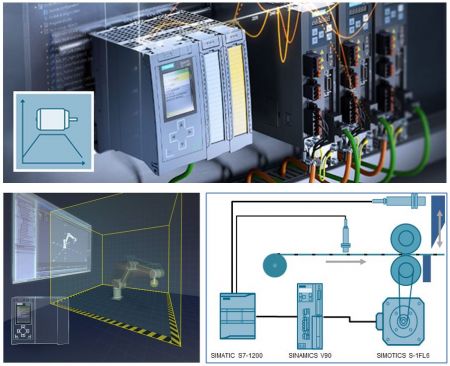
Totally Integrated Automation Portal software underpins nearly the entire Siemens industrial automation range. The team developed this software in response to the multi-vendor problem, aiming to create massive time savings when integrating new products from their range onto the floor.
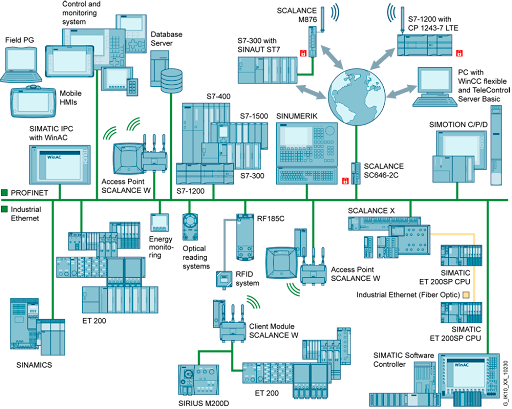
The core goal was simple: a single source of truth. This is what separates a totally integrated automation environment from a multi-vendor one. Instead of navigating multiple software environments or losing time synchronising tags, the TIA Portal keeps information from all integrated automation components in one place. Engineers can drag and drop information from one piece of hardware to another, so they no longer need multiple manual setups.
How does this help?
- No translation layer. Every small translation between systems builds up over time, consuming power, data, time, and money across years of operation.
- Remote access to the entire system. All totally integrated automation parts are networked and completely visible whenever you access the system, remotely or not.
- A clear view of all data. For reporting and finding efficiencies that improve day-to-day outcomes, a clear view of all data (rather than data siloed across different software environments) helps a lot.
- Time savings of up to 30% on implementation and operation. For bringing new, fully integrated automation parts onto the floor and operating them daily, this approach creates massive time savings. No sidestepping or finagling between different software environments.
So, the core question remains: is it worth upgrading to a Totally Integrated Automation system with totally integrated automation parts from the Siemens range? The case is strong, especially if you are ready to invest in a major capital upgrade. The efficiency and data integration alone are major boosters, and when you factor in simplified maintenance and a more scalable, unified architecture for future growth, the benefits start to compound.
If you are an established facility with a functioning multi-vendor environment, a wholesale replacement might not be the right answer. Installing totally integrated automation parts stage by stage makes the most sense, rolling out the change over time to create a practical path to a fully integrated automation environment.
Alternatively, you may be a machinery manufacturer or OEM, and parts of your existing multi-vendor automation system will eventually reach end of life, which forces a change. This is a great chance to evaluate how Siemens Totally Integrated Automation could improve your engineering efficiency and then replicate it throughout the solution's sales life.
It also makes any ongoing maintenance contracts you sell far easier to action over the machine's lifetime. Your end customers will also benefit from the efficiencies of Totally Integrated Automation as they run the machines they purchase from you, enhancing the commercial competitiveness of your offer.
Roll out Totally Integrated Automation with CNC Design
At CNC Design, we've worked with New Zealand manufacturers on this question for over 35 years. As a certified automation solution partner for Siemens in New Zealand, we bring deep knowledge and expertise in selecting, designing, and programming Siemens control and drive technology.
Work with us to define and understand the real-world constraints facing your facility, then tailor a solution. Get in touch for a consultation with our in-house industrial automation experts today.