




High-speed motion control is, at its core, about precision. When a machine needs to hit the same sub-millimetre mark ten thousand times a day, "close enough" is more of a hope and a prayer than a realistic measurement of success.
Our team spends a lot of time helping local manufacturers find efficiencies in their operations, and one of the most effective places to look is undoubtedly your servo drive (especially if you have Siemens controllers installed).
While your standard variable-speed drive is great for spinning a pump or a fan, the more complex movements of modern manufacturing demand a bit more. If you pair a high-performance Siemens drive with a dedicated Siemens controller, you can meet and exceed that bar.
Pairing servo drives with Siemens controllers can significantly improve your motion control and system performance. Let’s take a look at how you stand to benefit.
More dynamic and precise.
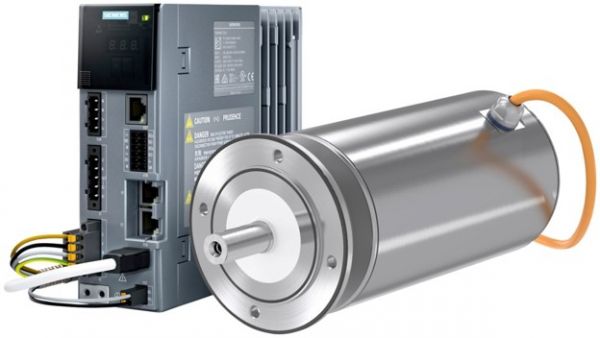
We often get asked when to swap a standard VFD for a servo drive. The answer usually comes down to two things: dynamics and positioning. A standard drive is a workhorse, but a Siemens servo drive is a precision athlete.
When you integrate a Siemens servo system, your controller uses closed-loop feedback to determine the shaft position at every microsecond. If there is even a slight increase in load or a mechanical hitch, the drive compensates instantly.
For applications like high-speed labelling, CNC machining, or robotic picking, that level of responsiveness can keep you moving without hiccups.
You work with just one piece of software.
This applies specifically to Siemens drive systems and controllers, but it’s too important not to mention. One of the biggest headaches our engineering clients face is undoubtedly software bloat. There’s one program for the PLC, another for the HMI, and a third, somehow clunkier, version just to commission the drives.
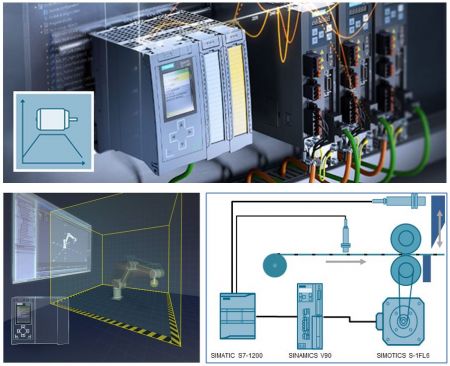
Siemens solved this with TIA (Totally Integrated Automation) Portal. By integrating your Siemens drive into this ecosystem, you’re working in a single sandbox. The controller you have installed will automatically register a new Siemens servo drive over PROFINET, pull the motor parameters, and let you tune that loop to perfection without having to jump between applications.
In short, you can turn what used to be a half-day commissioning job into something you can knock out in about twenty minutes. Not to mention, it’s far more adaptable thanks to the shared ecosystem.
Real-time communication without the bloat.
Speaking of a shared ecosystem and very little software bloat, there is another benefit hidden in there, too. The “secret” to these systems' reliability is a protocol called PROFIdrive. In a standard setup, there’s usually a tiny bit of lag (latency) between the controller sending a command and the motor reacting. In a high-speed environment, that lag is what will kill your floor’s productivity.
Using a native Siemens drive means your communication is better because it is deterministic. Your controller and drive are perfectly synced, so multiple motors move in perfect choreography without needing mechanical linkages or gears.
Smarter diagnoses and less guessing.
On top of that, this shared ecosystem offers faster diagnosis than siloed systems could ever achieve. There is nothing worse than an expensive machine sitting idle while an engineer stares at a flickering red light. Integrated Siemens systems take the guesswork out of troubleshooting. Because the drive is a native part of the control network, it can feed back incredibly specific data.
Instead of a generic error, the system can tell you if the motor is drawing too much current because a bearing is starting to seize, or if there’s a communication hiccup in a specific cable. This moves you away from "emergency repairs" and toward predictive maintenance. You fix the problem on a scheduled Tuesday, rather than a catastrophic Friday afternoon.
Minor efficiencies add up over time.
Manufacturing and similar industries are among the most staunch and stubborn, preserving techniques and methods that stretch back decades. That said, these industries are also among the most innovative in the world because competition pushes us to work harder for even the smallest efficiencies.
This is why it is important to find the small improvements over time. Improvements like opting for a servo drive, considering variable speed drives instead of direct online , or incorporating HMIs into your workflow. They save microseconds and minimise wear over many years, and while those changes might feel too small to be worthwhile, they’re often what compound to make the biggest difference to your bottom line.
In the same way, avoiding doing these updates ensures you fall behind competitors incrementally. For instance, as New Zealand industries continue to push for higher output and lower waste, the move toward fully integrated motion control is necessary.
When you choose a high-spec servo drive and a Siemens controller, you build a machine that is faster to set up, easier to fix, and significantly more accurate than anything that came before it. Taking the time to migrate your legacy system to this faster way of working will pay dividends for many, many years to come.
Talk to the team at CNC Design about migrating to Siemens drives.
Whether you’re considering a servo drive installation or you’re wondering whether variable speed drives are right for you, reach out to the team at CNC Design! We are proud to be New Zealand’s leading supplier of Siemens products, with local support dedicated to matching manufacturers with their ideal systems.
Get in touch with our automation experts today to learn more.