




One of the biggest issues with the factory days of old is that factory owners and floor operators were faced with two options when it came to optimising their lines:
- Obsessively record every single piece of data manually, which was almost impossible, or
- Work with broad patterns and hunches about the bottlenecks, issues, and other performance drains on their floor.
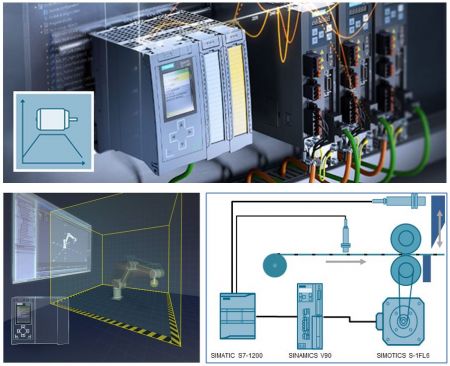
But these days, we don’t have to accept the black box of data. Updated PLCs, motion controllers, and drives offer in-depth data analytics (especially if you opt for components within an ecosystem like SIEMENS). This data is there for a reason. It helps floor owners like you improve your industrial automation performance, predict maintenance needs before they become disasters, and gain real-time insights to grow your business.
Today, let’s dive into how modern industrial components help you collect and interface with this data. We’ll also unpack some best practices for capturing and interpreting said data.
How Data Has Found a Place in Industry
If you’ve been in the industry for a while, then you know manufacturing plants have always generated massive amounts of data, whether or not it has actually been captured. Every single sensor, drive, and PLC currently on your floor is firing thousands of times per day. So, the issue is not a lack of data; it’s a lack of capture. This kind of data can remain trapped within each component or disappear into a buffer loop.
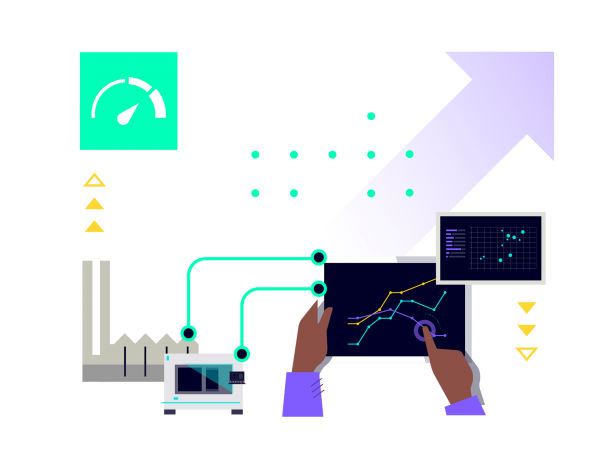
Industrial automation solutions have their place because they turn this incomprehensible mess of data and raw machine metrics into something helpful. Your engineers and operators have more information, no clipboard required, and these days smart automation components can stream structured data streams up to edge devices or cloud platforms.
The more complex and capable industrial components became, the more their capacity for data capture and interpretation grew. The more we captured and interpreted data, the more immediately useful automation insights we identified, and the more collectively motivated we were as an industry to build toward data capture.
Now that we have the capacity to measure and analyse data through industrial automation solutions, the question becomes: how do we use it?
We have some recommendations.
How Can Data Help Improve Industrial Automation Performance
When you integrate the ability to process massive amounts of data into your automation ecosystem, you immediately unlock the capacity to improve your system, both broadly and on a component-to-component basis.
True predictive maintenance.
Traditional maintenance schedules rely on time intervals or run-hours. It’s a bit like changing your car’s engine oil every six months, regardless of whether you’ve driven 500 kilometres or 50,000.
Data monitoring lets your system flag component wear long before a breakdown happens. You can order the parts and schedule the repair during a planned weekend shutdown to avoid catastrophic issues or unexpected downtime.
Eliminate bottlenecks.
Minor micro-stoppages happen, but they’ve also tended to fly under the radar. Individually, they don’t trigger a hard alarm, but they can still eat away up to 10% of your total output over the course of a month.
If you can see real-time data that aggregates the effects of these minor stoppages, you immediately see which point on the line is the bottleneck. Small, nearly-invisible points of optimisation like this are what’s so exciting about using data to monitor your industrial automation solutions.
Careful energy management.
Energy costs are no small matter and pose a significant operational burden for you. Modern drives, such as the Siemens SINAMICS range, track their power consumption, analyse energy profiles across different shifts or production points, and help your operators pinpoint peak demand surges. In response, you can build a map of energy usage on your floor or even reprogram certain machinery sequences to smooth demand, resulting in more cost-effective energy consumption.
Best Practices for Managing Your Internal Data
Once you dive in and commit to understanding your floor on a much deeper level, there is no looking back. The key to implementing all of these data-driven industrial automation solutions is to ensure you follow vital best practices for data hygiene and clear interpretation. For the moment, we want to focus on three simple pillars for industrial data interpretation:
- Don’t stream every single point of raw data to the cloud (it will cost you much more). Lean on industrial edge devices to collect, clean, and pre-process data locally at the machine level, then stream the aggregated trends upward.
- Standardise your communication protocols. Your hardware ecosystem should ideally use an open, well-tested system that enables new and old machinery to communicate with the same analytical dashboard.
- Focus on one specific KPI first, rather than trying to optimise your entire factory all at once.
In short, the data on your floor is only valuable if you know how to read it. This is why advanced industrial automation solutions have gained such a foothold in the industry: they enable you to extract meaningful intelligence and push your floor’s performance higher and higher.
Optimising your manufacturing floor? Automate with ease through CNC Design.
At CNC Design, we are proud to be New Zealand’s industrial automation solutions experts. Whether you’re doing a total overhaul of your system’s parts or you simply need to update your HMIs, our team is on hand to pair you with the right parts and software for the job.
Get in touch today to discuss your industrial automation.