





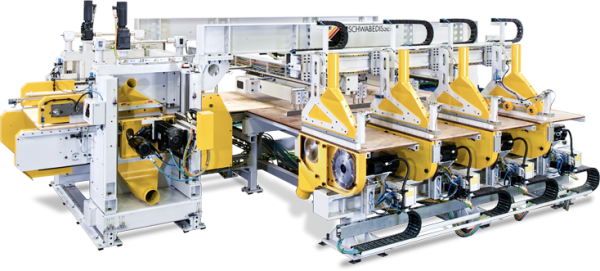
A safety retrofit on a working board line
Working with CNC Design, a busy Northland timber mill retrofitted modern safety systems onto existing machines in under a month. The upgrades better protect operators in their everyday work and extend the working life of machinery.
Like many established timber mills, this factory included saws and processing lines that had run reliably for decades but were built before our current safety standards. ‘We were dealing with solid machinery,’ says Cole Rumsey, who led the upgrade for the timber mill. ‘But they were lacking modern safety systems.’ They needed to limit access to certain areas and install safety sensors so the control system could automatically prevent access while machinery was operating.
CHALLENGE
Old machines that rely on manual operation
The task was to bring three machines – two cut-to-size saws and a sander – up to current safety requirements without replacing equipment that was still mechanically sound. The solution needed to improve safety during forklift loading and unloading of panels, as well as when operators needed to manually adjust the machines.
Previously, the machines had open access at the infeed and outfeed areas to allow forklift access. However, this also exposed operators to machine hazards during operation and manual adjustment. The key safety issue was to maintain the necessary forklift access while preventing uncontrolled operator access to hazardous areas.
For Cole, this was his first machine-safety project, and he needed a partner who could turn compliance requirements into plain language, develop a clear plan and deliver it around a busy production schedule. ‘CNC Design broke everything down into manageable steps,’ says Cole. ‘They had worked on the timber mill before, explained our options and helped us choose the right new automation components.’
SOLUTION
A wraparound safety solution
CNC Design designed a ‘wraparound’ safety system that let each machine’s operation run independently, but now with automatic safety triggers when someone approached the machine to carry out a task.
‘The brief was to make the workplace safe, but also operationally efficient,’ explains CNC Design’s Andreas Hamschmidt, who managed the project and led commissioning. ‘That meant introducing safety fencing, controlled access, and a system that ensures the machine is fully stopped before anyone can enter.’
At the heart of each installation is a Siemens S7-1500 Fail Safe PLC (programmable logic controller) that gathers inputs from light curtains and operator controls, then manages a safety-rated shutdown of the conveyor motors. For high-inertia components such as the flying saw, the safety PLC incorporates timed delays to ensure all motion has ceased before access is permitted. Pneumatic dump valves remove stored pneumatic energy on stop or lockout, preventing actuators from moving while someone is inside the guarded area.
A Fortress trap-key access system, combined with upgraded safety fencing, ensures the machine cannot be restarted until all access gates are closed and locked and every key is returned.
Crucially, each machine was split into infeed, processing and outfeed zones, so operators could keep loading and unloading while the core cutting process continued.
PROCESS
Good design, commissioned during planned downtime
‘We took less than a month to design and install the new systems,’ says Andreas. ‘The first installation established a robust approach that we then adapted to the specific requirements of the sander and second cut-to-size saw, with each changeover scheduled around planned maintenance windows.’
The timber mill wanted to standardise parts across the site, so Andreas worked to its existing supply chain. ‘They never insisted we use CNC Design’s preferred suppliers,’ says Cole. ‘They’d say, “These options will meet the standard. Who do you want to use?” That meant we could move quickly and keep things simple on our end.’
IMPACT
A safe machine that still works
The result, in Cole’s words, ‘wasn’t simply a safe machine, it was a safe machine that still worked efficiently.’ Operators can now access the machines for loading, cleaning and maintenance, with the risks associated with rotating equipment and stored pneumatic energy controlled.
Some tasks take a little longer, as operators wait for machines to reach a safe state before entering, but the tradeoff has been welcomed. ‘The biggest change has been the shift in safety culture,’ says Cole. ‘People understand why the procedures exist, they’ve adapted well, and they appreciate knowing they’ll go home safely at the end of the day.’
Where there had once been too many manual systems, with their potential for operator error, the systems now make hazards visible and controlled, helping prevent dangerous situations rather than reacting to them. And with the I/O communication headers already replaced, each machine is primed for the next phase of control systems and PLC programming upgrades when the time comes.
About CNC Design
For over 33 years, we have been leaders in industrial automation across Aotearoa New Zealand. As a Siemens automation and drives distributor, certified Siemens solution partner and the exclusive NZ distributor for Stäubli robots, we deliver complete automation solutions, from consultancy and system design to programming, installation, commissioning and ongoing field service. We build lasting relationships and turnkey systems that maximise machine performance and give our clients a genuine competitive edge.
Discuss Your Project
For more information you can call our team on +64 9 274 1280 or email cncnz@cncdesign.co.nz.